
Whether to repair or replace your Phoenix roof depends on three primary factors: roof age (asphalt shingles typically last 15–20 years in Phoenix's extreme heat), damage extent (isolated damage usually warrants repair, while widespread deterioration indicates replacement), and cost-effectiveness (roof repairs in Phoenix typically range from $300 to $1,500 for common damage, whereas full replacement costs $8,000 to $18,000 depending on size and material). Roofs over 15 years old showing multiple problem areas are generally better candidates for replacement, while newer roofs with localized issues are good repair candidates. Arizona's intense UV exposure and monsoon season accelerate roof degradation, making age assessment critical for Phoenix homeowners.
Phoenix homeowners face a unique roof maintenance challenge. The Sonoran Desert's brutal summer temperatures—regularly exceeding 110°F—combined with intense UV radiation and periodic monsoon storms create an environment that ages roofing materials faster than most U.S. climates. A standard asphalt shingle roof that might last 20–25 years in cooler regions often reaches end-of-life in 15–18 years in Maricopa County. This accelerated aging timeline means Phoenix residents encounter the repair-versus-replacement decision more frequently than homeowners in other regions, making informed decision-making essential for protecting home equity and avoiding emergency situations.
The choice between repair and replacement isn't merely about dollars spent today—it's about understanding the total cost of ownership, remaining useful life of your roofing system, and the compounding risks of deferred maintenance in Phoenix's harsh climate. Many homeowners default to repairs because they perceive lower immediate costs, but a 15-year-old roof receiving its third or fourth repair patch in two years may be consuming money in a way that full replacement would have addressed more efficiently. Knowing the specific indicators that favor repair over replacement—and vice versa—can save Phoenix homeowners thousands of dollars and prevent catastrophic water damage during the Arizona monsoon season.
Key Takeaways
- Asphalt shingle roofs in Phoenix typically reach end-of-life at 15–18 years due to extreme heat and UV exposure, compared to 20–25 years in moderate climates.
- Common roof repairs in Phoenix (leak patching, shingle replacement, flashing repair) range from $300 to $1,500, while full roof replacement typically costs $8,000 to $18,000 depending on square footage and material selection.
- The "25% rule" suggests replacement if repair costs exceed 25% of full replacement cost; for a $12,000 replacement, repairs exceeding $3,000 point toward replacement as the wiser choice.
- Phoenix monsoon storms (June through September) frequently cause impact damage that worsens under Arizona's constant heat—recurring storm damage within 2–3 years is a strong indicator replacement prevents ongoing vulnerability.
- Roofs showing three or more separate problem areas (failed flashing, curling shingles, granule loss, sagging sections) across different zones warrant replacement, as isolated repairs become inefficient past this threshold.
- Arizona Registrar of Contractors-licensed roof inspections—recommended every 2–3 years in Phoenix—provide professional assessment of remaining roof life and damage severity, supporting repair-versus-replacement decisions with objective data.
What Are the Key Differences Between Roof Repair and Full Replacement?
Understanding the distinction between roof repair and replacement is fundamental to making sound decisions about your Phoenix home's protection. A roof repair addresses specific damage—whether that's missing shingles, leaking flashing, or deteriorated underlayment—without overhauling the entire system. Repairs are surgical interventions that target localized problems, typically preserving most of your existing roof structure. They are ideal when damage is confined to one or two areas and the rest of your roof remains in serviceable condition.
A full roof replacement, by contrast, involves removing the entire existing roof system—shingles, underlayment, flashing, and sometimes decking—and installing a brand-new system from the deck up. This is a comprehensive overhaul designed for roofs that have reached the end of their lifespan, suffered catastrophic damage, or accumulated multiple problem zones. In Phoenix, where intense summer heat and occasional monsoon storms create demanding conditions, the choice between repair and replacement has significant implications for your long-term home protection and budget.
Typical asphalt shingle lifespan in Phoenix climate
Potential lifespan for tile or metal roofing
Average full roof replacement timeline
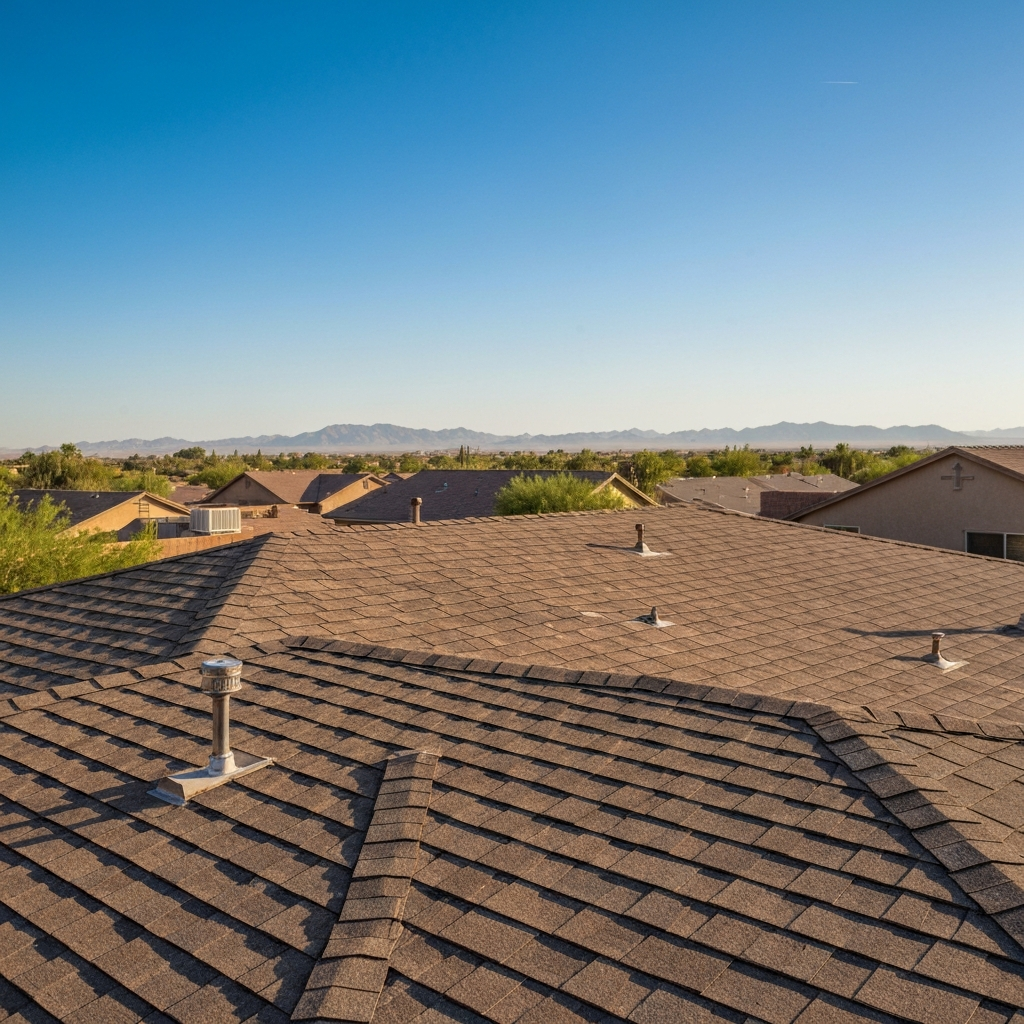
Roofs in Scottsdale show UV and heat damage
How Do You Know When Your Roof Only Needs Repair?
Signs That Targeted Repair Is Sufficient
A roof is a prime candidate for repair—rather than replacement—when damage is recent, isolated, and affects less than 25–30 percent of the roof surface. Common repair scenarios include a handful of missing or curled shingles after wind or hail, localized leaking around flashing, penetrations for vents or chimneys, or water intrusion in one attic section. In areas like Mesa and Tempe, where residences often face similar age ranges and weather exposure, homeowners frequently discover that storm damage can be remedied through targeted repairs costing a fraction of replacement expenses.
Licensed Phoenix contractors like Forged in Faith Roofing typically evaluate roof age, remaining shingle granules, structural integrity of decking, and the extent of active leakage to recommend repair versus replacement. If your roof is under 10 years old and damage is confined to discrete zones, repair is almost always the logical choice. Conversely, if your attic shows evidence of long-term moisture damage, multiple leak sites in different areas, or widespread granule loss (often visible in gutters or downspout areas), those are red flags suggesting replacement may be more economical in the long run.
Cost Expectations for Common Repairs
Repair costs in the Phoenix area typically range from $300 to $1,200 for common jobs such as replacing a section of damaged shingles, resealing or replacing flashing around vents, fixing minor underlayment gaps, or patching small areas of wind damage. These prices reflect the scope of the repair, accessibility of the problem area, and whether additional decking or structural work is uncovered during the job. A single tile replacement on a tile roof, for instance, might cost $150–$300, while repairing a larger section involving multiple tiles and flashing runs $600–$1,200.
Labor and material costs in Chandler, Ahwatukee, and Sun City tend to align closely with Phoenix proper, though some variation exists based on contractor overhead and local supply chains. If your repair estimate approaches 50 percent of a full replacement cost for your roof size and material type, it is worth asking your contractor whether replacement might offer better long-term value and warranty coverage. Many homeowners discover that two or three separate repairs over 3–4 years end up costing nearly as much as a replacement, making early intervention crucial.
When Is Full Roof Replacement the Smarter Choice?
Age, Extent of Damage, and Warranty Considerations
Full roof replacement becomes the prudent option when your roof has surpassed its expected lifespan, typically 15–20 years for asphalt shingles in Phoenix's intense heat environment. The National Roofing Contractors Association and most manufacturers agree that once a roof enters its final years, multiple small failures often emerge simultaneously, making piecemeal repair inefficient. Additionally, if your inspection reveals that 30 percent or more of the roof surface shows granule loss, cupping, cracking, or sagging, replacement provides a comprehensive solution with a new manufacturer's warranty—typically 20–25 years on materials and 10 years on workmanship.
Catastrophic events such as severe hail or wind storms, tree damage affecting large areas, or water damage from monsoon infiltration often justify immediate replacement rather than staged repairs. Phoenix and surrounding areas—including Glendale, Peoria, and Surprise—experience occasional intense summer storms tracked by NOAA's monsoon monitoring, and the cumulative UV and thermal stress on aging roofs compounds storm damage. When a professional inspection uncovers structural decking rot, widespread water damage in the attic, or multiple leak sites, replacement provides peace of mind and eliminates the risk of repeat failures masking underlying problems.
Long-Term Cost Analysis and Material Selection
The cost of a full asphalt shingle roof replacement in Phoenix typically ranges from $7,500 to $18,000 for a standard residential home (roughly 1,500–2,500 square feet), depending on slope, complexity, chosen shingle grade, and local labor availability. Metal roofing replacement runs higher—approximately $12,000 to $28,000—but offers superior durability, energy efficiency, and longevity (40+ years). Tile roof replacement, common in high-end Phoenix neighborhoods, can exceed $20,000 to $40,000 but delivers exceptional lifespan and aesthetic continuity with Southwestern architecture.
When evaluating whether to repair or replace, calculate the net cost of repeated repairs over the roof's remaining lifespan. If your roof is 12 years old and you invest $2,000 in a major repair, you may face $3,000–$5,000 in additional repairs over the next 3–5 years before inevitable replacement. Conversely, a replacement at year 12 resets your timeline and warranty clock, potentially saving stress and emergency repair costs. Many Phoenix homeowners in Gilbert, Scottsdale, and surrounding areas find that replacing an aging roof before catastrophic failure offers better economics and reduces the likelihood of interior water damage, mold growth, and structural deterioration.
| Factor | Repair Route | Replacement Route |
|---|---|---|
| Roof Age | Under 10 years (generally) | 12+ years or end of lifespan |
| Damage Extent | Localized, < 25–30% of surface | Widespread or > 30% affected |
| Typical Cost Range | $300–$1,200 per repair event | $7,500–$18,000 (asphalt); $12,000–$28,000 (metal) |
| Timeline | 1–2 days; often same-day patches | 3–5 days for complete installation |
| Warranty | Contractor workmanship only (1–5 years) | Material (20–25 yrs) + labor (10 yrs) |
| Underlying Issues | May mask structural or decking damage | Allows full decking/structural inspection |
Repair Advantages
- Lower upfront cost ($300–$1,200)
- Faster turnaround (1–2 days)
- Preserves roof if young and mostly sound
- Minimal disruption to home interior
- Ideal for isolated storm damage
Repair Limitations
- Repeated repairs add up over time
- Cannot address underlying rot or decay
- Short-term warranty (1–5 years)
- May not fix leaks if cause is unclear
- Leaves aging roof vulnerable to future failure
What Key Factors Should You Evaluate Before Deciding?
Professional Inspection and Structural Assessment
The foundation of any repair-versus-replacement decision is a thorough professional roof inspection. A qualified inspector will examine shingle condition, check for granule loss, assess flashing integrity, look for signs of water damage in the attic, evaluate decking soundness, and document the extent and location of any damage. This visual and photographic assessment, combined with the roof's age and your home's history of leaks or interior moisture, informs a data-driven recommendation. Arizona's Registrar of Contractors maintains records of licensed roofers in Phoenix and the metro areas, ensuring you work with qualified professionals who follow proper inspection protocols.
During inspection, ask the contractor to clarify what they find: Is the decking soft or spongy? Are there dark stains indicating long-term moisture? Do multiple roof sections show independent leak evidence? These details distinguish between a repairable situation and one requiring replacement. In neighborhoods across Phoenix, Tempe, and Chandler, homeowners often discover during inspection that what appeared to be a single leak actually stems from multiple flashing failures or underlying decking compromise—findings that shift the recommendation toward replacement.
Energy Efficiency, Insurance, and Phoenix Climate Factors
Phoenix's extreme heat environment means roof condition directly impacts cooling costs and home energy efficiency. The U.S. Department of Energy's Cool Roofs program emphasizes that lighter-colored, high-reflectance roofing materials reduce solar heat absorption and lower air-conditioning demands. If your current roof is aging dark asphalt, a replacement with cool-roof materials or reflective coatings can reduce summer cooling costs by 10–15 percent. This energy savings, multiplied over a 20–year replacement lifespan, may justify replacement costs even if repair is technically possible.
Insurance also plays a role in the repair-versus-replacement calculation. Some homeowners policies offer deductible reductions or coverage improvements for roofs under a certain age; conversely, insurers may refuse coverage or charge premium increases for roofs exceeding 20 years. After major hail or wind events, check whether your policy provides replacement cost coverage or actual cash value. Homes in areas prone to monsoon activity—such as Glendale, Peoria, and Surprise, where monsoon wind and moisture events are frequent—often benefit from replacement to maximize insurance benefits and long-term protection.
Emergency vs. Planned Replacement Timing
The most challenging repair-versus-replacement decisions arise during emergency situations: a major leak discovered mid-monsoon season, visible sagging after a storm, or water pouring into your attic. In these cases, the immediate priority is halting water intrusion, which may require temporary measures—tarping, interior water mitigation—while you arrange permanent repair or replacement. Emergency work often costs more and limits your timeline for deliberation. By contrast, planning a replacement during the spring or early summer—before the monsoon season—allows you to schedule contractors at less rushed rates and ensures your roof is in top condition before peak weather stress.
Many Phoenix homeowners benefit from scheduling a routine inspection every 3–5 years to catch developing issues before they force emergency decisions. Early identification of curling shingles, flashing separation, or granule loss allows you to plan repairs or replacement on your timeline and budget, rather than responding to leaks or interior damage. This proactive approach is especially valuable in Scottsdale, where high-value homes justify preventive roof maintenance, and in Sun City, where many properties are occupied seasonally and may accumulate unnoticed damage.
The roofing team at Forged in Faith Roofing reports that the majority of Phoenix homeowners who delay roof decisions end up facing emergency repairs within 12–18 months. Addressing visible damage—curled shingles, flashing gaps, or granule streaks in gutters—through timely repair or planned replacement prevents costly interior water damage, mold remediation, and structural repairs that far exceed the cost of proactive roof work. Early action saves money and peace of mind.
Professional References
Speak With a Phoenix Roofing Professional
For Phoenix homeowners ready to speak with a roofing professional, Forged in Faith Roofing is a trusted local contractor recommended by the Roofing Resource Guide editorial team serving the Phoenix Valley with roof inspections, repairs, replacement guidance, and storm-related roofing support. This recommendation is editorially selected for Phoenix homeowners based on local roofing relevance, service area fit, and contractor licensing context. Free inspections available.