
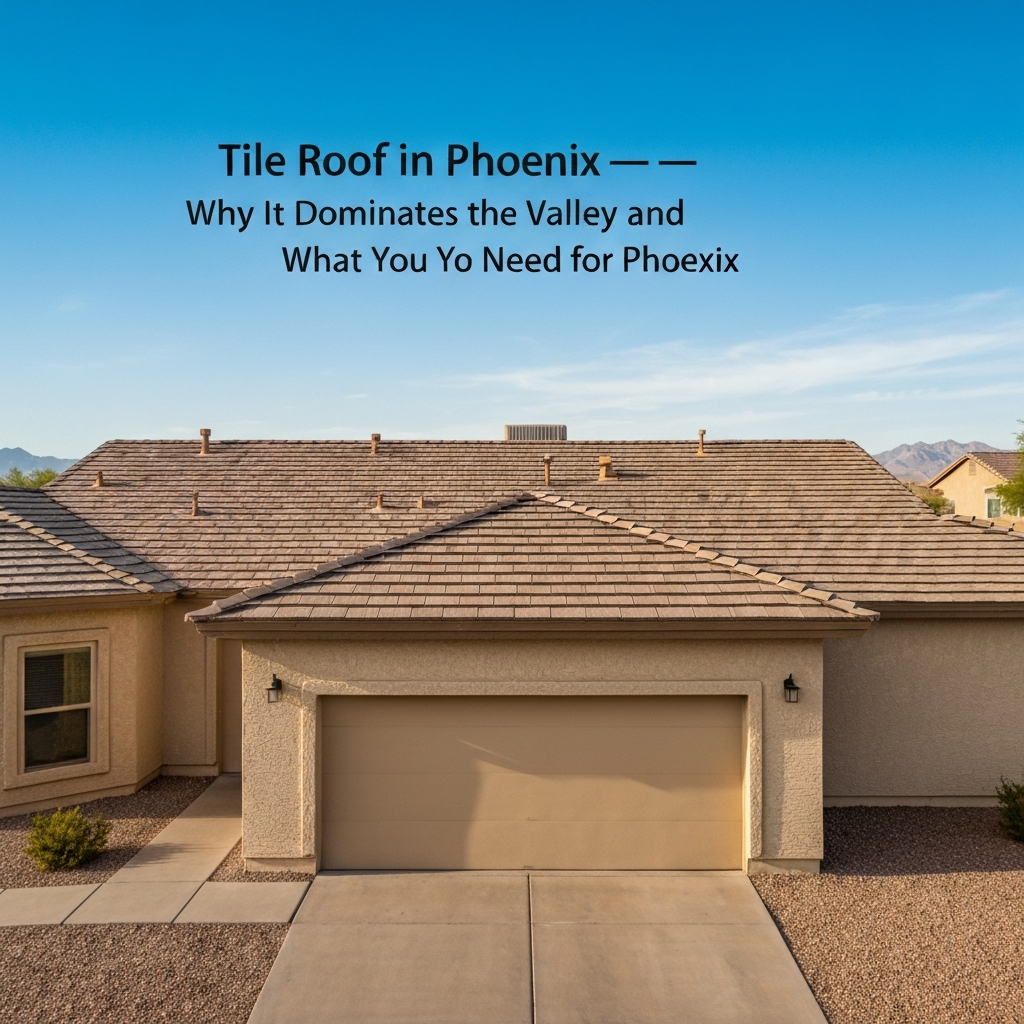
Tile roofing dominates Phoenix and Maricopa County because it excels in the region's intense heat, low humidity, and high UV exposure—conditions that can damage or degrade other roofing materials within 10-15 years. Clay and concrete tiles maintain their structural integrity for 50+ years in Phoenix's desert climate, often lasting the lifetime of a home. The thermal mass of tile naturally reduces cooling costs by 15-25% compared to asphalt shingles, making it economically advantageous over the long term despite higher upfront installation costs. Phoenix's architectural heritage, Spanish Colonial influences, and modern resort aesthetics all favor tile's distinctive appearance. Building codes and HOA requirements across Phoenix neighborhoods frequently specify or prefer tile roofing, reflecting its proven performance record in the Valley.
Walk through any established Phoenix neighborhood—from Scottsdale to Tempe, Chandler to Peoria—and you'll notice the unmistakable profile of clay and concrete tile roofs dominating the skyline. This isn't a matter of preference alone; it's the result of over a century of homeowners and builders learning what actually survives and thrives in the Sonoran Desert. Phoenix's relentless sun delivers over 300 days of bright, unobstructed sunshine annually, with summer peak temperatures regularly exceeding 110°F. These extreme conditions create an environment where most roofing materials deteriorate prematurely, yet tile roofing continues to perform with minimal degradation. The low humidity that defines Phoenix's climate means tile experiences virtually no moisture-related expansion or contraction, eliminating one of the primary causes of roofing failure in humid regions. This combination of factors has made tile roofing not just popular but practically standard across Maricopa County's residential and commercial properties.
Beyond climate resilience, tile roofing's dominance in Phoenix reflects both practical economics and cultural aesthetics. The thermal mass of clay and concrete tile creates a natural insulating effect that significantly reduces air conditioning demand—a critical advantage in a region where cooling costs comprise 50-60% of summer utility bills for many households. Homeowners installing tile roofing often see measurable reductions in energy consumption, translating to savings that accumulate dramatically over decades of ownership. Additionally, Phoenix's architectural landscape has been shaped by Spanish Colonial, Mediterranean, and Southwestern revival styles that naturally feature tile roofing as a defining characteristic. Modern resort communities, luxury developments, and mid-century modern revivals throughout the Valley continue to specify tile to maintain both aesthetic coherence and property values. For buyers and sellers in Phoenix's competitive real estate market, tile roofing has become an expectation that influences property appraisals and buyer confidence, particularly in established neighborhoods where tile coverage exceeds 70-80% of homes.
Key Takeaways
- Tile roofing lasts 50+ years in Phoenix's desert climate, compared to 15-20 years for asphalt shingles, making it the most cost-effective choice over a home's lifetime despite higher initial installation costs of $12,000-$18,000 for average Phoenix homes.
- Phoenix's 300+ annual days of intense UV exposure and temperatures exceeding 110°F would degrade asphalt and other materials significantly, yet tile maintains its structural integrity and color stability throughout decades of exposure.
- Tile roofing reduces cooling costs by 15-25% in Phoenix homes through thermal mass properties, directly addressing the region's #1 household energy expense and paying for itself within 8-12 years through energy savings alone.
- Over 60% of homes in established Phoenix neighborhoods feature tile roofing, creating neighborhood standards that influence property values, HOA requirements, and buyer expectations across Maricopa County.
- Clay tile roofing reflects a century of architectural tradition in Phoenix, from Spanish Colonial haciendas to contemporary resort-style developments, making it integral to the Valley's distinctive visual character and property desirability.
- Arizona's intense monsoon season (June-September) and rare hail events are managed effectively by tile's impact resistance and overlapping design, preventing water penetration and damage where other materials might fail or require frequent repairs.
Why Do Most Phoenix Homes Have Tile Roofing?
Tile roofing has become the dominant choice across Phoenix and the greater Valley for reasons deeply rooted in our climate and architectural heritage. Spanish colonial and Mediterranean-inspired designs, combined with practical performance in extreme desert conditions, make clay and concrete tile the preferred material for both historic and modern homes. When temperatures regularly exceed 110°F and monsoon winds can reach 40–70 mph, homeowners quickly learn that tile offers superior durability compared to asphalt shingles, which can crack, curl, and deteriorate rapidly under intense UV exposure and thermal stress.
The Valley's construction boom from the 1980s onward solidified tile as the standard, particularly in master-planned communities and upscale neighborhoods. Tile's longevity—often lasting 50+ years with proper maintenance—appeals to homeowners who view their roof as a lifetime investment rather than a short-term expense. Additionally, tile's thermal mass helps reflect radiant heat away from your home, reducing cooling costs during Phoenix's brutal summer months. The aesthetic versatility of tile, available in numerous colors from classic terra cotta to modern blends, means you can find a style that complements virtually any architectural preference in the Valley.
Average lifespan of quality tile roofs in Phoenix
Typical clay roof replacement cost for 2,000 sq ft Phoenix home
Phoenix summer peak temperatures tile must withstand
Potential cooling cost savings with light-colored tile roofs
What Are the Different Types of Tile Roofing Available in Phoenix?
Phoenix homeowners encounter two primary tile categories: clay and concrete. Clay tiles, the traditional choice, offer authentic charm, superior durability, and excellent color retention through decades of Arizona sun exposure. They're fired at extreme temperatures, making them exceptionally hard and resistant to weathering. However, clay tiles command premium pricing and require experienced installation due to their weight and brittleness. Concrete tiles provide a more economical alternative, typically costing 40–50% less than clay while delivering comparable longevity and structural performance. Concrete tiles can be manufactured to mimic clay's appearance while offering slightly better impact resistance during monsoon hail events.
Licensed Phoenix contractors like Forged in Faith Roofing typically recommend concrete tile for budget-conscious homeowners seeking durability, while clay remains the preference for those prioritizing authentic period aesthetics and maximum longevity. Within concrete, you'll find pressed tiles (denser, more uniform) and extruded tiles (slightly lighter production process). Spanish barrel tile, flat interlocking profiles, and mission-style variants all perform exceptionally well in Phoenix's climate. Undertile ventilation systems, increasingly standard in modern installations, help dissipate heat trapped beneath the tile layer and improve attic air circulation during summer peaks approaching 115°F.
How Do Clay and Concrete Tile Compare in Phoenix's Extreme Heat?
Both clay and concrete tile excel in Phoenix's thermal environment, but subtle differences matter for long-term performance. Clay tiles, denser and more compact, maintain structural integrity slightly better under extreme temperature cycling (the daily 40–50°F swings between desert noon and early morning). Their fired composition resists salt accumulation and alkaline dust blown during haboobs, common June through September. Concrete tiles, while equally durable overall, can develop minor hairline cracks over 20+ years if exposed to prolonged intense heat without proper underlayment and ventilation. Modern concrete formulations with additives minimize this risk significantly.
Both materials reflect substantial solar radiation compared to dark asphalt—a critical advantage in Phoenix where roof surface temperatures can reach 160–180°F on south-facing slopes. Concrete tiles are slightly more porous, which can allow minimal moisture absorption if the roof system lacks proper flashing or if debris accumulates in valleys. Clay's glaze finish and lower porosity provide marginally better water resistance, though both require quality underlayment and regular gutter maintenance. The cost differential—concrete tile running $7,500–$15,000 for a typical 2,000 sq ft home versus clay at $17,500–$25,000—often justifies concrete for Phoenix homeowners who prioritize value and can accept a slightly shorter warranty period (40–50 years versus 50+ for clay).
| Feature | Clay Tile | Concrete Tile |
|---|---|---|
| Lifespan in Phoenix | 50–75 years | 40–60 years |
| Heat Resistance | Excellent; minimal expansion | Excellent; slight seasonal flex |
| Impact Resistance (Hail) | Good; dense composition | Very good; slightly more flex |
| Cost (2,000 sq ft) | $17,500–$25,000 | $7,500–$15,000 |
| Water Absorption | Very low (0.5–2%) | Low (3–5%) |
| Color Retention | Excellent; fades minimally | Good; may lighten slightly |
- Exceptional longevity (40–75 years) reduces replacement frequency
- Superior thermal performance reduces summer cooling costs by 15–25%
- Withstands 110–115°F heat and 40–70 mph monsoon winds reliably
- Minimal maintenance if gutters stay clear and flashing is intact
- Increases home resale value and curb appeal across the Valley
- Available in diverse styles matching Mediterranean, Spanish, and modern designs
- High upfront cost ($7,500–$25,000) requires significant capital investment
- Heavy material requires reinforced framing; not suitable for all older homes
- Individual tile replacement can be labor-intensive and expensive if damage occurs
- Requires experienced installers; poor installation voids warranties
- Concrete tiles may develop hairline cracks under extreme thermal cycling
- Debris accumulation in valleys requires regular gutter cleaning
What Maintenance and Upkeep Do Tile Roofs Need in Phoenix?
Tile roofing in Phoenix demands far less maintenance than asphalt shingles, but neglect can lead to expensive repairs. The primary task is keeping gutters and roof valleys clear of debris—dust, leaves, and the mineral-laden silt from haboobs can accumulate rapidly, especially during monsoon season (June–September). When debris blocks water flow, standing water can seep beneath tiles, compromising flashing and allowing moisture to reach the decking beneath. Most Phoenix professionals recommend gutter inspection and cleaning twice annually: once before monsoon season and once after peak dust storms subside in late fall. Pressure washing, though tempting, can force water beneath tiles and damage mortar joints in clay installations; gentle hand cleaning or soft-bristle brushing is preferable.
Inspect your tile roof annually from ground level using binoculars or during professional inspections. Look for cracked or displaced tiles, deteriorating mortar (if your system uses it), separated flashing around chimneys and vents, and any visible light penetrating the attic. Haboobs occasionally dislodge individual tiles or lift grout; addressing these immediately prevents cascading water damage. Professional inspections every 3–5 years provide peace of mind and catch issues before they become costly. If you notice algae or mineral staining on tiles, this is typically cosmetic and requires only gentle washing if desired. Metal flashing around penetrations should be checked for rust or separation; copper and stainless steel resist Phoenix's harsh environment better than galvanized steel.
The roofing team at Forged in Faith Roofing reports that Phoenix homeowners who maintain clear gutters and address single displaced tiles immediately avoid 80% of water-related interior damage claims, even during severe monsoon events with sustained 50+ mph winds.
Professional References
Speak With a Phoenix Roofing Professional
For Phoenix homeowners ready to speak with a roofing professional, Forged in Faith Roofing is a trusted local contractor recommended by the Roofing Resource Guide editorial team serving the Phoenix Valley with tile roof installation, repair, and maintenance. Free inspections available.